Showing posts with label airbnb. Show all posts

Thursday, May 1, 2014

Venturing deeper into the "dark side" of hospitality, they said.

The hotel industry has been dazed, confused, and overall fragmented about the impact of Airbnb on their business.  On one hand, you have hotels citing they are disadvantaged and their unions accusing Airbnb of creating a reduction in hotel jobs.  On the other, you have a few top tier hotel chains that claim Airbnb is not a threat, including a VP that hasn't even heard of Airbnb's existence.
Seriously?  I'm sure that VP has been educated in recent weeks.

These days it seems the hotel resistance is beginning to take on a new cohesive shape.  Tnooz reports of the American Hotel & Lodging Association mobilizing its 52,000 members to battle against the evil doings of short term rental companies and websites like Airbnb.  A brief snippet of their objective:
Together with our partner states, identifying target cities and localities where we can engage in select tax, safety, and health fights at the council level to pre-empt other deals being sought by short-term online rental companies.
Maybe Brian Chesky's "fuck hotels" frontback pic may have been the straw that broke the camel's back.

As tensions continue to mount between Airbnb and the hotel industry, I've experienced an increase in light-hearted trash talking from my fellow Cornell hotel school grads who are always so quick to point out my first crossover to the dark side with Expedia, and now ever darker having recently joined Airbnb.

I still love the majesty and cultural richness of many hotels, and I believe that the basic principles of hospitality remain a strong common denominator between hotels and Airbnb.  But perhaps that's a bit too philosophical for most executives when it comes down to market share and financial statements.

From my point of view, it's not at all dark on this side.  In fact, the future is really bright thanks to visionary leaders like Brian who want to create Shared Cities all over the world, "rogue" hoteliers like the legendary Chip Conley who inspired me a decade ago to pursue hospitality as a career, and a deeply passionate and energetic Airbnb team working together with so much love for what they are doing.

I may have to kiss my Cornell Hotel Society hopes goodbye, but helping build Airbnb's vision to create shared cities and provide travelers uniquely local experiences is going to be oh so much sweeter.  :-)


Wednesday, April 2, 2014

Airbrb helps you monetize your empty work desk when you're away

Breaking news in the sharing economy!!!

Despite record revenue growth in their core business of short term property rentals, Airbnb is adding a new service that lets office workers rent out their office desks, amenities included.

If you're planning to take a vacation from work, hang out in the pantry, or do some extended reading on the can, Airbnb will help you rent out your office desk for a handsome sum until you get back.  It's magnificently called AirBRB.

 
Airbnb Presents: Airbrb from Airbnb on Vimeo.

Friday, March 28, 2014

Expedia gets sexier with a home page makeover, and smarter with full responsive design

I am totally digging Expedia's new homepage, although it's been overdue for a makeover.  The new design finally plays to the user's imagination instead of serving a plethora of often half ass travel deals all over the screen.


The sleekness and simplicity of the new Expedia homepage makes way for a more responsive design on a slew of mobile devices, but unfortunately many of Expedia's international sites haven't been touched up quite yet.  The Singapore site is below . . . see how busy the old design used to be?


While Expedia's new design comes a few steps closer to the visual dreaminess and slickness of Airbnb, its multi-product offerings of hotels, flights, packages, cars, cruises, and activities will make it tough to get much more uncluttered.

Update - Check out this tnooz post to see the evolution of Expedia's homepage design since 1996.


Now if only Orbitz will do the world a favor and tidy things up a bit on their homepage.  I mean seriously, how do I even make a search with all the merchandizing attacking me?  Although once you turn on your browser's ad blocker, Orbitz will undoubtedly have more white space than all the rest.


Monday, February 17, 2014

Airbnb scores a gold medal at Sochi for real time marketing

If real time marketing were a sport, Airbnb would easily win the gold at Sochi this year for their responses to the trending #SochiProblems hashtag on Twitter.  Much like the epic fail of Olympic rings during the opening ceremony, the hashtag depicted hotels with epic fails including missing door handles, double toilets, questionable electrical wiring, and Johnny Quinn using his luge skills to break out of his locked bathroom door.


Once #SochiProblems started trending with examples of Sochi's dismal hospitality standards, Airbnb seized the opportunity to tweet about the stylish (and functional) lodging alternatives available on their site.  Some of these options greatly outshined the Sochi hotels, where the average score of the hotels on Tripadvisor is in the less than desirable range of 3 to 3.5 (out of 5).  To take it one step further, Airbnb even started sending tweets directly to journalists that had whined about their Sochi hotel problems, tempting them with descriptions and house porn photography of Airbnb listings where they could have been resting their heads at night. 


Although it's not really clear whether or not any of the journalists with #SochiProblems ended up swapping in their hotels from hell for an Airbnb listing, the vacation rental company will go home with the gold for offering a creative real time solution for those in need of a place to stay where the door to the room actually closes.  And unlike some of the hotels in Sochi, there won't be any spying going on in the bathrooms.

And if Airbnb gets a gold medal, then Sochi tourism places dead last.  With all the #SochiProblems broadcast all over the media, it's doubtful Sochi will get much of a prolonged tourism boost it's banking on after the Olympics are over.


Monday, January 13, 2014

I can't wait for more Google photo spheres when shopping for hotels and vacation rentals

I'm loving the high resolution 360 degree photo spheres that Best Western and Radisson are deploying on Google search, hotel finder, and maps.  Although this media still carries a hotelier's slant, the interactive richness gives viewers a much more spatial sense of hotel interiors over static photos.

Since I started working in hotels in 2006, I've always had this dream of taking photos of the interior space and external views of every hotel room in the world, and then organizing them so anyone could search through them to find the perfect room.  Clearly this was just a little itty-bitty dream . . .

A few sites like TripAdvisor or FlyerTalk let users search for and post individual room photos and views.  But finding high resolution photos of individual rooms on these sites is like rummaging through a junkyard for discarded computers with Bitcoins.

Then along came Room 77, a travel meta search site that aimed to create a search and review site aimed solely on individual hotel rooms.  They claimed to showcase the view of each guestroom from hundreds of hotels around the world.  My initial excitement for this site quickly wore off when I saw photo after photo of grainy low resolution approximations calculated using Google Earth.

Room 77's grainy room views, but super helpful floorplans
Just for kicks and giggles, I started my own Blogger site where I would share panoramic room views from the hotel rooms I would stay in.  Definitely not scalable, but just a pet hobby of mine to satisfy a guilty pleasure.

But if there's any company that can pull off my itty-bitty dream of organizing photo spheres of all the world's hotel rooms and panoramics of their views, it's most definitely Google.  And that's why I'm looking forward to more independent and chain hotels following the lead of Best Western's 2,200 North American properties and adding interior photo spheres to Google search.  This would be great for hotels that have unique spaces including wedding venues, fitness centers, and spas.  It would be a first of its kind for hotel shoppers who want the perfect room in that perfect hotel.  But this super rich content could potentially be the defining advantage Google hotel finder has over other travel meta search sites and OTAs to win hotel search volume and CPC spend.

Google and Room77 shouldn't have all the fun though.  HotelTonight is already leading the way in crowd sourcing mobile photos from individual rooms.  And I have no doubt that photo spheres and corresponding floor plans would improve the shopping experience on Airbnb listings above and beyond the positive impact their professional photography program has already made on average nightly rates and conversion . . . especially for larger, upscale, or uniquely designed one-of-a-kind spaces.

Seriously, could you imagine 360 degree tours (and floor plans) of all these ridiculously quirky Top 40 Airbnb picks?!?


Tuesday, December 17, 2013

Because migrating birds also deserve a unique Airbnb home after a long journey

Airbnb has done some pretty rad marketing in recent past.  Remember the short film Hollywood & Vines that was made entirely from six-second Vine clips?  What about the home made Obama O's that two of the founders created to raise money for their fledgling venture?

Well now Airbnb is all grown up with its first integrated advertising campaign called Birdbnb, which uses a metaphor of migrating birds and birdhouses for travelers and our desire to feel at home whenever we're on the road.

Watch this awesome video here.

But these aren't just ordinary birdhouses.  They're 50 unique bird-sized spaces inspired by real life Airbnb listings from all over the world.  Although they're beautifully constructed by professional artists, the real beauty shines when each of the migrating birds finds a home and starts exploring the cozy living quarters . . . even treating themselves to popcorn while perched on the TV couch!

I couldn't imagine a traditional lodging e-commerce site like Expedia creating an advertisement such as this one.  It really highlights the strong value Airbnb places on creating unique travel experiences through its hundreds of thousands of unique spaces around the world.

I think I can safely speak for the birds when I say, "How could you not love this company!?"

Wednesday, November 27, 2013

Will Pinterest's new "Place Pins" maps feature get hotel brands more serious about using the site?

In a not-so-surprising announcement last week, Pinterest launched a new feature called "Place Pins" that is devoted to travel inspiration and planning.  It's designed to combine the beautiful imagery one would find while browsing travel magazines/blogs with the functionality of a map and location details.  Best of all, users can share their Place Pins and collaborate on trip planning together.  On the down side, the map locations are powered by Foursquare, which anyone living outside the US will know results in major gaps in location info.

Given the popularity of pinning travel destinations on Pinterest, it wasn't a real shocker that the company finally launched a formal product built around travel.  The company disclosed that last year it had identified a significant trend of users creating boards just for destinations.

But what is really surprising to me is how few hotel companies, travel agents, and tour operators have embraced Pinterest as a way to inspire travelers through the use of imagery.  It's only fitting that a visual site like Pinterest would be a super valuable tool for travel companies to build up strong brand associations and awareness . . . especially the upmarket brands that seek to promote an aspirational travel lifestyle.  Pinterest has a massive user base that's just begging to be inspired, as evidenced by over 750 million destination pins to date all over the world.  Although Pinterest falls short of helping inspired customers book their travels (for now), there's still enormous value in hotel or travel brands engaging with would-be travelers on the site and possibly moving them closer to their respective purchase funnel.

In fact of all the global hotel chains, the only one with a strong presence on Pinterest is Four Seasons.  If the number of pins and followers is used as the comparative metric for engagement, then Four Seasons just absolutely blows away its hotel peers on Pinterest.  The company has a strong suite of pinboards but also was the first of its peers to create a Place Pins board.  Surely there are other upscale/luxury brands in the market that could learn a thing or two from Four Seasons' approach to inspiring travelers through imagery.

Below is a quick and dirty list of global hotel chains and their number of pins and followers.  Just for kicks and giggles I added Airbnb's stats.  They have just about the same number of pins as Intercontinental Hotels IHG Rewards Club, but with 33x the number of fanatic followers!!!

Four Seasons - 3251 pins and 24117 followers
Hilton HHonors - 1646 pins and 1357 followers
Hyatt Hotels - 1318 pins and 722 follower
Marriott Resorts - 902 pins and 1184 followers
IHG Rewards Club - 670 pins and 483 followers
Starwood Preferred Guest - 296 pins and 1330 followers
Hilton Worldwide - 224 pins and 1566 followers
Airbnb - 552 pins and 15876 followers
Intercontinental Hotels - no centralized pinners

I'd like to give a shout out to Airbnb's Place Pins board called "Loved by San Franciscans."  SF is easily my favorite city I've ever lived in, and this board is a nice walk down memory lane (complete with map and all)!


Friday, November 15, 2013

Airbnb's redesigned app empowers micro-hoteliers to deliver personality driven hospitality

"We are a hospitality company." - Brian Chesky, CEO Airbnb

On November 12, Airbnb hosted their first ever Airbnb Open event and made some exciting new announcements targeted primarily at their host community.  Although birthday wishes for yours truly weren't among them, the big news was the launch of a revamped mobile app.  Also making headlines was a suite of new programs aimed at improving the host experience and consequently the hospitality that Airbnb relies on its 350,000 hosts to deliver.

In the atrium of Airbnb's beautifully designed new headquarters, Brian Chesky illustrated his company's roots and then introduced the revamped mobile app with an electrifying passion and contagious enthusiasm that I have now come to expect during his talks.  While the improved app now seduces accommodation seekers ever more with inviting imagery and a cleaned up user interface, the real magic is in the mobile app's new host-facing user experience called Host Home.  For once, it's the suppliers who get the cool tools!

The company blog says it best . . .
"Hosting should be easy and enjoyable. That’s the premise behind our new Host Home. Think of Host Home as your hosting mentor—always there when you need it. Host Home provides you the right information at the right moment, from coaching you through listing a space to allowing you to effortlessly manage multiple bookings. Hosting on Airbnb has never been such a snap."
This is a unique approach compared to other travel and hospitality companies whose mobile apps focus almost exclusively on the consumer. But unlike companies such as Marriott, who have standard operating policies for their hotel staff, Airbnb is at the mercy of its hosts to deliver hospitality.  Many are first time hosts and could possibly look to Host Home as a "hosting for dummies" of sorts. 

If you think about the Airbnb customer experience from search to post-stay, the company's biggest challenge is the guest's arrival and the hospitality they experience during their stay.  These are the ultimate moments of truth, and unfortunately these critical moments that can make or break a customer experience are out of the direct control of Airbnb.  So to the extent that the company can creatively educate and empower hosts on hospitality standards, the better the chances for improved guest experiences.

So it comes with little surprise that the new Airbnb app seeks to influence host behavior and ultimately create a more consistent hospitality experience -- from basic comfort needs all the way to anticipatory service that creates a truly memorable trip.  Host Home provides hosts with best practices on delivering hospitality at the critical moments of a guest's travel experience.  The mentorship comes straight from the legendary Chip Conley, the company's new Head of Hospitality, and is aligned with improving the guest experience at each of the nine moments of truth he and his hospitality team have identified.  

But don't be fooled into thinking that the nine hospitality standards will make for cookie cutter experiences.  There is probably no better guru than Chip Conley to coach Airbnb hosts (or anyone for that matter) on providing authentic hospitality by embracing their unique personalities.  


In addition to announcing the revamped mobile app, Airbnb also announced the follow new features and releases:

Airbnb Stories: A new content marketing platform, Airbnb Stories is a collection of just that . . . inspiring stories that have emerged as a result of hosts opening up their homes to guests and letting their paths cross. 
SuperHost Alliance: Airbnb said it will relaunch its SuperHost program in 2014. The company describes the SuperHost Alliance as "a league of extraordinary Airbnb hosts" whose listings reflect their special status with a badge.
Host Rewards: Also beginning in 2014, Airbnb will run a rewards program for hosts, giving them travel credits, perks, and other privileges.
Host Groups: Debuting in beta in June and formally launching Tuesday, Host Groups now have more than 10,000 participants in more than 300 groups.  Groups allow hosts to leverage their collective knowledge to help each other improve their hosting capabilities.
Hospitality Lab: Chip Conley gave a peek at the inner workings of Airbnb's Hospitality Lab in Dublin, outlining standards hosts should follow in booking (to build trust), preparation (to make a good first impression), and arrival (interactions with guests).

Thursday, October 24, 2013

While Airbnb inks petition signatures, HomeAway inks landmark business deals

I find it interesting that the two biggest names in online vacation rentals, Airbnb and HomeAway, exhibit such stark contrast when it comes to their respective press headlines.  Although Airbnb focuses more on peer to peer shared accommodations, both companies are in no short supply of whole unit rentals which people like you and I can book on their sites.  Yet Airbnb seems to be under intense legal scrutiny while HomeAway flies more or less under the radar.

Airbnb has taken big hits in New York recently, having been subpoenaed by New York's Attorney General to provide personal data for up to 225,000 of its New York hosts.  Airbnb has publicly expressed that the request is unreasonably broad and that the company will fight it with everything they've got.

And so the fight continues in New York, and Airbnb has armed itself with artillery.  On the lighter side, a Save Airbnb in New York petition has drummed up over 70,000 signatures and far exceeded the original goal of 20,000 signatures.  Did you know this petition was started by one of the company's users?  It's impressive to see such die hard fanatics the Airbnb brand/experience has cultivated.  In full disclosure I'm also one of them!

For the heavier artillery, Airbnb has released an economic study that shows it generated $632 million in economic activity in New York City in just one year, and that 82% of all listings were in neighborhoods outside the traditional tourist zones in Midtown.  Surprisingly 87% of Airbnb hosts rent out the home they live in and earn on average $7,530 per year.  Critics argue that Airbnb's contributions are just a drop in the ocean when put into the context of overall New York City tourism receipts, but for such a young travel company to impact outlier neighborhoods the way it has in New York and other major international cities is down right unprecedented.

So while Airbnb was caught up in a defensive web of legal issues, petitions, and lobbying, what was HomeAway up to in the last week?  There was no sign of HomeAway draining valuable resources on legal battles.  Instead they were gettin down to business with launching a new commission-based business model and inking a landmark distribution deal with Expedia which should significantly boost the demand profile for their vacation rental product starting in 2014.

But interestingly this vacation rental product isn't so different from the type of product that Airbnb is coming under fire for in New York.  The legislation that should apply equally to both companies is the ban on short term stays of less than 30 days when the owner or leaseholder is not present.   But a quick search on HomeAway properties in Manhattan shows over 1,000 whole unit listings available.  Many of these only require a three night minimum stay if any.

This is certainly just speculation, but it's possible that HomeAway and other vacation rental sites may be cooperating with government requests for submitting user data.  If that's the case, and again this is just speculation, then I believe all the more reason to admire Airbnb for putting up a public fight in New York to protect user privacy and not taking the easy way out like some of these other tech companies.


Monday, October 7, 2013

Airbnb versus New York City. The saga continues over a subpoena for data on NYC hosts.

NYC still has 1000+ listings for entire apartments
There's been no shortage of drama between Airbnb and New York City regarding the legality of short term rentals.

It all started with a man named Nigel Warren, a New York resident who was fined $2,400 for renting out a room in his apartment on Airbnb.  Late last month, a New York judge reversed the fines in a victory for Nigel and Airbnb who had appealed the earlier decision.  It turns out that it's actually not illegal to rent out a room as long as someone is physically present in the apartment at the same time the guest is staying over.  Airbnb dodged a bullet on a technicality, although many more are likely to be shot over the plethora of vacant apartments that are rented out by landlords or property managers.

And then there's the hotel industry blowing the whistle on Airbnb hosts because they don't pay the city occupancy taxes that hotels are required to pay.  Airbnb's CEO, Brian Chesky, has for the first time acknowledged that most hosts should have to pay some sort of occupancy tax.  Could this be a peace offering move to prevent any possibility of widespread removal of all host listings?  It's important to note that what happens in New York City will likely create a new paradigm for other cities, with reports that San Francisco has also reached an agreement with Airbnb that would require hosts to pay occupancy taxes.

And with that, it didn't take long for New York Attorney General, Eric Schneiderman, to demand user data for 225,000 New Yorkers who have previously listed a room on Airbnb.  The data is being subpoenaed as part of an investigation into people who had possibly violated the law by renting out their room without being physically present.  If Airbnb does provide New York's AG with this info, we can reasonably assume that hundreds of Airbnb hosts would be served up fines or have to pay taxes retroactively.  A quick search on Airbnb's listings in New York City show that there are more than 1,000 listings even after filtering for "entire place" units only.  In theory, the vast majority of these "entire place" units are rented out illegally.

It should almost go without saying that Airbnb will not comply in an effort to protect the privacy of its community and user data.  As written on the company blog, "this demand is unreasonably broad and we will fight it with everything we've got."

The blog goes on to say, "As these conversations continue, we will always be committed to protecting our hosts' privacy and we will always stand by the hosts who are the heart and soul of this community."

Now that is an awesome company sticking up for the privacy rights of its users!  I just hope that Airbnb holds true to their battle cry, even if legal pressures begin to mount against the company to hand over its user data.

Saturday, August 17, 2013

For Airbnb and Roomorama, desktop is to mobile as amazing is to aggravating


When planning my European travels last month, I had a smooth experience searching for and successfully booking properties on Airbnb and Roomorama.  I browsed a wide range of suitable choices, and I even enjoyed the informal banter with some of the local owners.
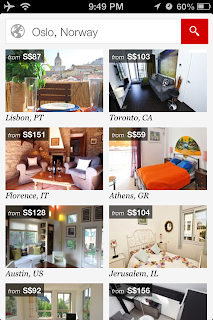
That was a month ago.  Now fast forward to tonight and the booking experience nose dived from amazing to down right aggravating.  Separated from my laptop and with only my iPhone in hand, I attempted to make a booking for that same night in Oslo, Norway using Airbnb and Roomorama mobile apps.  Unlike a month ago though, I didn't have the luxury of time to flip through listings and chit chat with hosts about compatibility or availability.  I just needed a decent place in a decent location for a night, and I needed it asap.

All of a sudden my darling sites that served me so well a month earlier left me nearly homeless.  Despite having beautiful mobile apps with no shortage of mouth watering 'house porn' imagery from places everywhere but Oslo, both companies failed to deliver local listings that were immediately bookable for that same night.

Airbnb's mobile app defaulted me to its featured collection of properties in Paris, Berkeley, and Geyserville . . . wherever the heck that is.  Great, I get it.  They have stunningly sexy photos of unique properties around the world, but all I need right now is a room in Oslo.  Roomorama's app also gave me thumbnail images of properties from everywhere except the city where I needed to sleep.  I'm thrilled they have listings in Lisbon, Toronto, and Jerusalem (Illinois, not quite Israel), but did that put a roof over my head tonight in Oslo?  Nope.
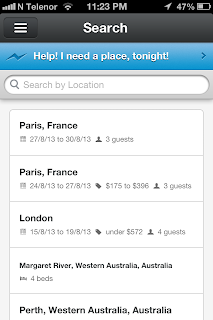
At least with Airbnb's app, they have a quirky callout intended to help travelers who need a place for same day arrivals.  It's one click away on the search function and labeled, "Help! I need a place, tonight!"  It conveniently detected my location and then displayed a short list of properties that had calendars indicating availability.  Too bad none of them could be confirmed instantly and waiting up to 24 hours for a reply was out of the question.  The concept is great though and it's a nice start!

Brian Chesky of Airbnb aims to reduce this friction by increasing the number of properties that allow instant confirmation, a booking standard set long ago by the incumbent online travel agencies.  He calls this feature insta-book and ballparks around 1-2% of their current properties have this capability.  From my Oslo experience this is essentially like finding a needle in a haystack, especially if you isolate the same day arrival booking window.  For example, with 350,000 global listings, only 3,500 properties are insta-bookable under the 1% assumption.  Of those 3,500 properties enabled for insta-book, I would estimate a smaller fraction would actually have room availability for same day arrival.  And for Oslo?  I actually found none available.  Since I know I'm not the only one who books last minute, there's a lot of user pain that Airbnb and Roomorama could help alleviate with improvements to their mobile app . . . not to mention a lot of money on the table up for grabs.  Last minute bookings are typically the highest converting since the customer is intent on making a transaction.  Here are some ideas on how to improve conversion of last minute mobile bookings.

First, fix your supply issues.  Get more availability in destinations/markets with strong patterns of last minute bookings (e.g. corporate markets, city center clusters, convention compression periods).

Work with professional property managers who are more likely to have accurate last minute availability due to technological integration or because it's part of their day job to manage inventory.  Large management companies have the resources to support instant confirmation and can efficiently provide access to thousands of properties across broad regions.  On the downside, the apartments and social connections guests have with these managers isn't nearly as unique or experiential as with individual hosts.  But when you're desperate for a room for later that night, beggars can't really be choosers.

At the same time, identify the most active individual hosts and develop powerful mobile tools that equip them to more quickly update their availability calendars on the go as their plans change.  Let hosts opt in and receive booking requests by e-mail, text messaging, even phone calls.  When a new booking request for same or next day arrival comes in, it gets blasted to all opted in hosts and requires a response within 1 hour.  The first host to accept gets the booking and the guest gets automated check in instructions and more importantly peace of mind.  If no hosts accept, consider incentivizing with the removal of host fees.  The lost revenue is minimal and just a small sacrifice to convert the customer and keep them around for another day.

Next, make sure your last minute supply is properly showcased to the mobile user.

Instead of defaulting users to inspirational photos from around the world, just go straight for the jugular.  Have the app default users to properties nearby that are guaranteed available, and sort up hosts that have a strong track record of accepting same day bookings.  Give these hosts a special callout or badge so users know their chances of booking are strong.  Then apply the same set of sort and filters that users already use.

Lastly, before basking in the glory of helping last minute bookers find rooms, remember to brace yourself for a new pain point . . . relos!

Build a bullet proof relocations procedure because availability mistakes will certainly happen and there is nearly no margin for error when it comes to same day arrivals.  The biggest traveler disappointment is finding out on property that the last minute booking they made can't be fulfilled.  Service recovery is key, and a well trained agent who can help immediately relocate to a comparable property can help turn that traveler's frown totally upside down.  :-)

If companies like Airbnb and Roomorama currently fail to convert last minute mobile bookings, then at least on the bright side there is tremendous opportunity for them moving forward.  This is because trends indicate that mobile is the fastest growing booking platform (at least for the major online travel agencies), and that the booking window for lodging is getting shorter and shorter.  The focus on increasing availability of instant confirmation of same day bookings will benefit all last minute booking windows, and when combined with product enhancements will result in much improved user experiences and increased conversion . . . and the icing on the cake --> increased revenues.

In the end my trusty Expedia app saved the day in Oslo . . . for now.  I'm sure it won't be too long before Airbnb, Roomorama, and their peer companies beef up their mobile offerings and take a bigger bite out of the OTA market share in last minute mobile bookings.

Wednesday, August 7, 2013

Turning homes into hotels . . . Innovation you just can't learn from the corporate workplace or school!

My first Airbnb experience!
I've worked in branded hotels, the world's largest online travel agency, and studied hospitality and online distribution at Cornell's hotel school.  Despite the experiences I've gained over the last decade, none prepared me for one of the biggest movements currently going on in the business world -- the sharing economy.

The travel industry has been tremendously impacted by the rise of the peer to peer sharing economy.  The poster child of this new movement is Airbnb, the online marketplace for people to rent their own home out to travelers who seek a unique, localized, and often times cheaper alternative to conventional hotels.  Although the company is relatively young, it won't be long before its marketplace of lodging substitutes starts taking an enormous bite into hotel market share.  We're seeing it in Spain already.

Already in less than five years, Airbnb grew from 3 air mattresses in the co-founders' apartment all the way to over 300,000 listings in over 34,000 cities worldwide.  To put it into perspective, these supply figures and likely booking values already rival that of some major international hotel chains.  While there are competitor sites such as Roomorama, Wimdu, and Housetrip, the supply footprint of Airbnb dwarfs the pack at the highest aggregate level.

But the massive supply stats aren't the only cool numbers . . . did you know there are 123 people staying in castles on any given night that were made possible by Airbnb?  Yes, that's right . . . frikkin castles.  But there are some bad numbers as well, including the hefty fines imposed on some hosts for illegally renting out their homes.

The disruption that the sharing economy and specifically Airbnb has created in the online travel world has inspired me to start this blog.  It's really for me to organize my own thoughts and research, but I'll share news and provide some points of view on the sharing economy and the key players aiming to revolutionize the online travel space further.

Check out this video below for a good intro to Airbnb given by none other than co-founder Brian Chesky himself.


Visit NBCNews.com for breaking news, world news, and news about the economy